Most requested for
Balcony open-edge safety
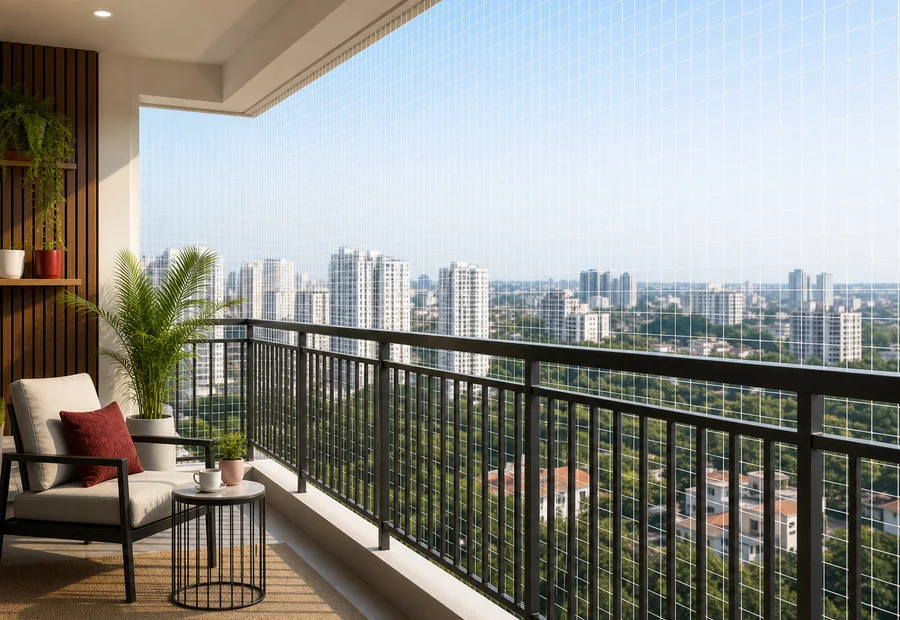
Families usually ask for balcony nets when railing gaps feel too open, pets move near the edge, children use the balcony, or pigeons and debris enter through exposed sides.
Balcony safety for Bangalore homes
A balcony safety net should make the open edge feel more controlled without turning the balcony into a closed box. The right installation is measured around railing gaps, ceiling height, side walls, plant corners, pet movement, and the way your family actually uses the space every day.
Measured for apartment balconies, high-rise openings, windows, ducts, and utility edges
Planned around railings, grills, hooks, pipes, tile surfaces, and society rules
Most requested for
Families usually ask for balcony nets when railing gaps feel too open, pets move near the edge, children use the balcony, or pigeons and debris enter through exposed sides.
Preferred finish
A clean installation uses the right mesh size, supported edge rope, secure fixing points, and balanced tension so the net does not sag or look temporary.
Base location
Nagamma Safety Nets works from the Marathahalli side and serves Bangalore apartments, villas, rented homes, and high-rise communities.
Site fit
Balcony Safety Nets work looks simple from far away, but the lasting result depends on small site details. The right work starts by reading the balcony, window, or utility opening before choosing a fitting method.
Many Bangalore balconies include curved rails, glass sections, side gaps, planter ledges, AC drain pipes, sliding windows, and uneven corners. The net should be marked after checking the full opening, not priced only from a quick photo.
Open towers in areas such as Marathahalli, Whitefield, Bellandur, Hebbal, and Sarjapura can face strong crosswind and rain. A loosely tied net may flap, sag, or pull at weak hooks over time.
Some societies limit drilling on outer walls, glass railings, or facade-facing areas. The installer should understand where hooks can be placed and how to keep the outside look tidy.
A good balcony net keeps light, airflow, plant care, clothes drying, and cleaning access usable. The goal is controlled openness, not a dark or awkward balcony.
Installation views
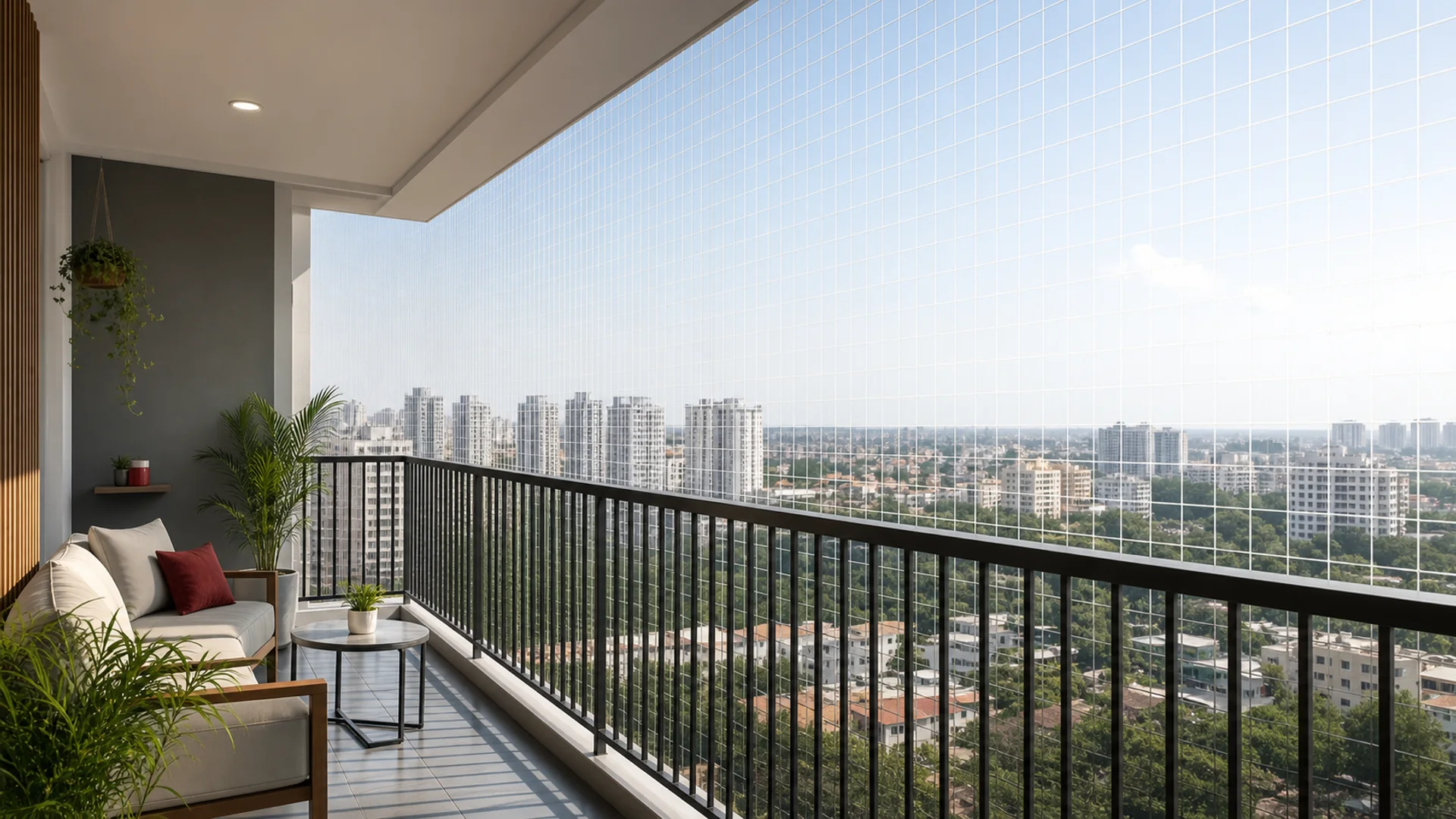
These views show the kind of balcony faces, window openings, and utility areas that need measured installation instead of a quick one-size-fits-all setup.
Materials
The net is only one part of the job. A reliable installation also needs the correct mesh size, edge support, fixing points, and a finish that works with the balcony surface.
| Part | Ask this | Good choice | Why it matters |
|---|---|---|---|
| Net material | Is the net UV-stabilized HDPE, nylon, or a cheaper short-life mesh? | Weather-ready HDPE or nylon mesh selected for balcony exposure | Balconies face sun, rain, dust, and wind. Poor mesh can weaken, fade, stretch, or tear faster than expected. |
| Mesh size | What mesh gap will be used for my balcony purpose? | Smaller mesh for child, pet, and pigeon concerns; larger mesh only where suitable | Mesh size changes visibility, airflow, bird control, and how safely the opening is covered for the actual use case. |
| Border rope | Will the edge be supported with rope or only tied directly to hooks? | Strong border rope with even lacing around the balcony opening | The border carries tension across the net. Without it, the mesh can sag, bunch, or tear near fixing points. |
| Hooks and anchors | Which hooks suit concrete, tile, metal railing, glass railing, or side wall fixing? | Fixing method chosen after checking the surface and apartment restrictions | The strongest net still depends on the fixing points. Weak hooks or wrong anchors are the usual reason a net loosens. |
| Tension and finish | Will the net be tightened neatly without pulling the railing or leaving loose corners? | Balanced tension, straight lines, closed side gaps, and accessible cleaning edges | A neat finish looks better from inside and outside, lasts longer, and avoids pockets where birds or debris collect. |
Ask this
Is the net UV-stabilized HDPE, nylon, or a cheaper short-life mesh?
Good choice
Weather-ready HDPE or nylon mesh selected for balcony exposure
Why it matters
Balconies face sun, rain, dust, and wind. Poor mesh can weaken, fade, stretch, or tear faster than expected.
Ask this
What mesh gap will be used for my balcony purpose?
Good choice
Smaller mesh for child, pet, and pigeon concerns; larger mesh only where suitable
Why it matters
Mesh size changes visibility, airflow, bird control, and how safely the opening is covered for the actual use case.
Ask this
Will the edge be supported with rope or only tied directly to hooks?
Good choice
Strong border rope with even lacing around the balcony opening
Why it matters
The border carries tension across the net. Without it, the mesh can sag, bunch, or tear near fixing points.
Ask this
Which hooks suit concrete, tile, metal railing, glass railing, or side wall fixing?
Good choice
Fixing method chosen after checking the surface and apartment restrictions
Why it matters
The strongest net still depends on the fixing points. Weak hooks or wrong anchors are the usual reason a net loosens.
Ask this
Will the net be tightened neatly without pulling the railing or leaving loose corners?
Good choice
Balanced tension, straight lines, closed side gaps, and accessible cleaning edges
Why it matters
A neat finish looks better from inside and outside, lasts longer, and avoids pockets where birds or debris collect.
Compare
Balcony Safety Nets can be the right answer for many homes, but it is not the right answer for every balcony or window problem. This comparison keeps the decision honest.
| Option | Best for | Strength | Limitation | Choose when |
|---|---|---|---|---|
| Balcony safety net | Open apartment balconies, railing gaps, pet movement, and general edge control | Keeps the balcony airy while adding a visible protective layer across the opening | Needs proper hooks and periodic checks; not a substitute for adult supervision or structural railing repair | You want practical open-edge protection without fully closing the balcony view. |
| Invisible grill | Higher-finish balcony and window safety where a cleaner long-term look is important | Strong stainless-steel cable system with a more permanent architectural finish | Usually setup needs more and may need stricter drilling or frame planning | You want a polished safety barrier and the apartment allows the fixing method. |
| Pigeon safety net | Balconies mainly affected by pigeon entry, nesting, droppings, and AC ledge mess | Focused on closing bird entry points with mesh and edge sealing | May not be specified strongly enough for child or pet safety expectations unless planned that way | Bird control is the main problem and the balcony edge risk is secondary. |
| Child-focused safety net | Homes where children use the balcony or railing gaps feel risky | Can use tighter mesh, stronger edge support, and more careful gap closure | Still needs supervision and should be checked regularly after use and weather exposure | The main concern is reducing open gaps and creating a more controlled balcony zone. |
| Temporary rope or DIY net | Short-term use in low-risk, low-height spaces | Quick and simple setup when permanent work is not allowed | Often looks untidy, loosens quickly, and may not handle wind or load well | You need a temporary stopgap and understand its limits clearly. |
Best for
Open apartment balconies, railing gaps, pet movement, and general edge control
Strength
Keeps the balcony airy while adding a visible protective layer across the opening
Limitation
Needs proper hooks and periodic checks; not a substitute for adult supervision or structural railing repair
Choose when
You want practical open-edge protection without fully closing the balcony view.
Best for
Higher-finish balcony and window safety where a cleaner long-term look is important
Strength
Strong stainless-steel cable system with a more permanent architectural finish
Limitation
Usually setup needs more and may need stricter drilling or frame planning
Choose when
You want a polished safety barrier and the apartment allows the fixing method.
Best for
Balconies mainly affected by pigeon entry, nesting, droppings, and AC ledge mess
Strength
Focused on closing bird entry points with mesh and edge sealing
Limitation
May not be specified strongly enough for child or pet safety expectations unless planned that way
Choose when
Bird control is the main problem and the balcony edge risk is secondary.
Best for
Homes where children use the balcony or railing gaps feel risky
Strength
Can use tighter mesh, stronger edge support, and more careful gap closure
Limitation
Still needs supervision and should be checked regularly after use and weather exposure
Choose when
The main concern is reducing open gaps and creating a more controlled balcony zone.
Best for
Short-term use in low-risk, low-height spaces
Strength
Quick and simple setup when permanent work is not allowed
Limitation
Often looks untidy, loosens quickly, and may not handle wind or load well
Choose when
You need a temporary stopgap and understand its limits clearly.
Process
Good balcony safety nets work should feel measured and calm. The installer has to understand the opening, fixing points, safety expectation, and how the space will be used after the job.
The first step is to ask why the net is needed: child safety, pet movement, pigeon entry, objects falling, plant protection, or a mix of these. That purpose decides mesh size, tension, and fixing style.
The balcony face, side gaps, railing height, ceiling beam, tile edges, glass panels, pipes, and corners should be measured properly. Photos help, but final planning is better after checking the actual site.
The installer should recommend mesh type, rope thickness, hook spacing, and corner treatment based on wind exposure, balcony shape, and whether the work is for general protection or tighter family safety.
Hooks or anchors are placed carefully so the net can be laced with balanced tension. Tile, concrete, metal railing, and side-wall fixing each need a different touch.
Before leaving, the installer should check the side gaps, bottom line, top edge, loose corners, door movement, plant access, clothes drying space, and cleaning access.
Tell the installer whether the main concern is children, pets, pigeons, falling objects, or general balcony control.
Ask what net material, mesh size, rope thickness, hook type, and hook spacing will be used.
Confirm if your apartment society allows drilling on the required surfaces.
Look carefully at side gaps near walls, railing corners, AC pipes, and planter ledges before approving the finish.
Ask how often the net should be checked and what to do if a hook, knot, or corner loosens later.
Inspect hooks, knots, and edge rope after heavy rain, strong wind, or any accidental pulling.
Do not hang heavy pots, swings, cloth lines, lights, or storage items from the safety net.
Clean dust and bird droppings gently with water and a soft brush instead of pulling the mesh.
Keep sharp metal edges, plant stands, and furniture corners away from the net surface.
Call for a check if you notice sagging, torn mesh, loose hooks, or a corner opening near the railing.
Areas
Start with the nearest area page. Marathahalli is the business base, and the same service route is available across Bangalore.
Open page
Open page
Open page
Open page
Open page
Open page
Open page
Open page
Open page
Open page
Open page
Open page
Open page
Open page
Open page
GMB location
Open page
Open page
Open page
Open page
Open page
FAQ
These answers are written for real buying decisions: material, drilling, airflow, children, pets, and future repair work.
For most apartment balconies, a UV-stabilized HDPE or good nylon mesh with strong border rope and secure hooks is a practical choice. The best mesh size depends on whether the concern is children, pets, pigeons, falling objects, or general open-edge protection.
They can help reduce open gaps and make the balcony feel more controlled, but they should not be treated as a replacement for adult supervision or a proper railing. For homes with children, ask for tighter gap planning, stronger edge support, and careful bottom and side closure.
Yes, many pet owners use balcony nets to reduce open-edge risk for cats and small dogs. The installer should plan smaller gaps, tight corners, and strong bottom fixing because pets often test edges and corners.
A properly fitted safety net keeps the balcony open and airy, but it will still be visible. White or transparent-looking mesh can look lighter from inside, while darker mesh may be less noticeable from a distance depending on the background.
Sometimes limited fixing can be done around existing railings or frames, but most secure balcony safety net work needs hooks or anchors. If your apartment has drilling restrictions, tell the installer before booking so they can check possible fixing points.
A standard apartment balcony can often be completed in a few hours after measurement and material selection. Larger balconies, high-rise access, multiple sides, or difficult drilling can take longer.
Yes. The mesh, hooks, knots, and edge rope should be checked occasionally, especially after heavy wind or rain. Any sagging, torn section, or loose hook should be repaired early instead of waiting for the net to fail.
Balcony safety net visits are planned from Marathahalli toward Whitefield, Bellandur, KR Puram, HSR Layout, Sarjapura, Electronic City, JP Nagar, Yelahanka, Hebbal, Kengeri, Thanisandra, and nearby homes where lower edges, side gaps, children, pets, or falling-object concerns need checking.
Search the service with your Bangalore area to open the correct matching page path.
Marathahalli, Bangalore
Share the service, area, and a few photos of the opening. The visit can be planned around the surface, access, material, and daily use of the space.