Most requested for
Balconies and terraces
The usual concern is monkeys entering open areas, disturbing plants, damaging items, or creating unsafe moments near children and pets.
Heavy-duty balcony protection
Monkey safety nets are needed when monkeys enter balconies, terraces, open ducts, or utility spaces and regular light netting is not enough. The work has to be planned for strength, tight edges, safe fixing, and humane prevention without hurting the animal.
Planned for balconies, terrace sides, open shafts, utility areas, and villa edges
Focused on strong material, tighter border fixing, and practical access control
Most requested for
The usual concern is monkeys entering open areas, disturbing plants, damaging items, or creating unsafe moments near children and pets.
Preferred material
Monkey netting needs stronger mesh, tighter border support, and better fixing points than light bird-control netting.
Base location
Nagamma Safety Nets serves Bangalore from Marathahalli, with work planned after checking building access, height, and opening shape.
Site fit
Monkey Safety Nets work looks simple from far away, but the lasting result depends on small site details. The right work starts by reading the balcony, window, or utility opening before choosing a fitting method.
Homes near trees, open plots, lake roads, and terrace lines can see monkeys using railings and pipe routes. The net should close reachable entry points, not just the front face.
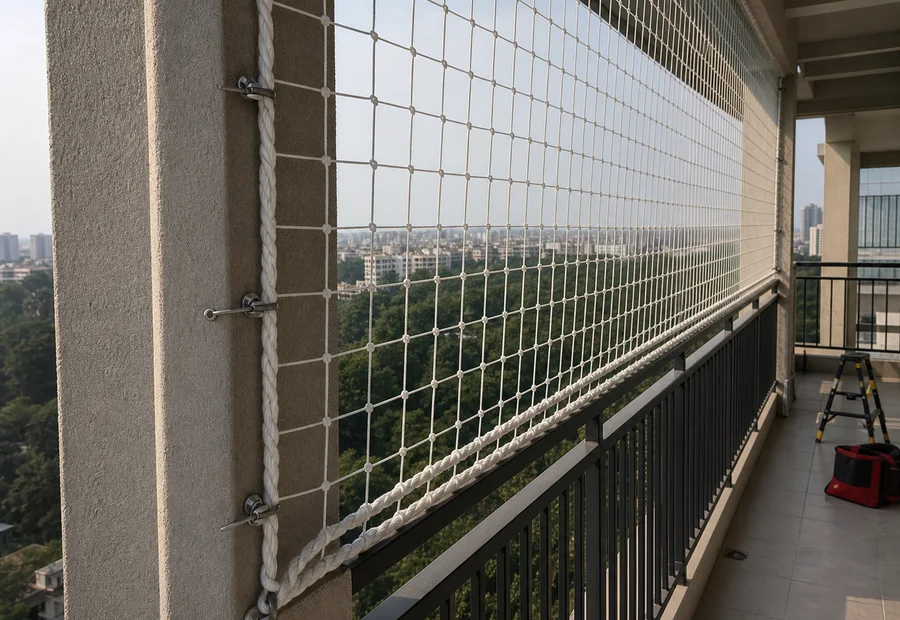
A terrace or open side usually needs a strong boundary rope or support cable. Loose netting can sag, flap in wind, and become easy to pull at the edges.
Even after netting, food waste, fruit bowls, open bins, and visible packets can attract monkeys. A good prevention plan includes the way the balcony is used every day.
Some balconies have solid side walls, while others have tiles, metal railings, or hollow sections. The installer should inspect the surface before deciding hooks, clamps, or anchors.
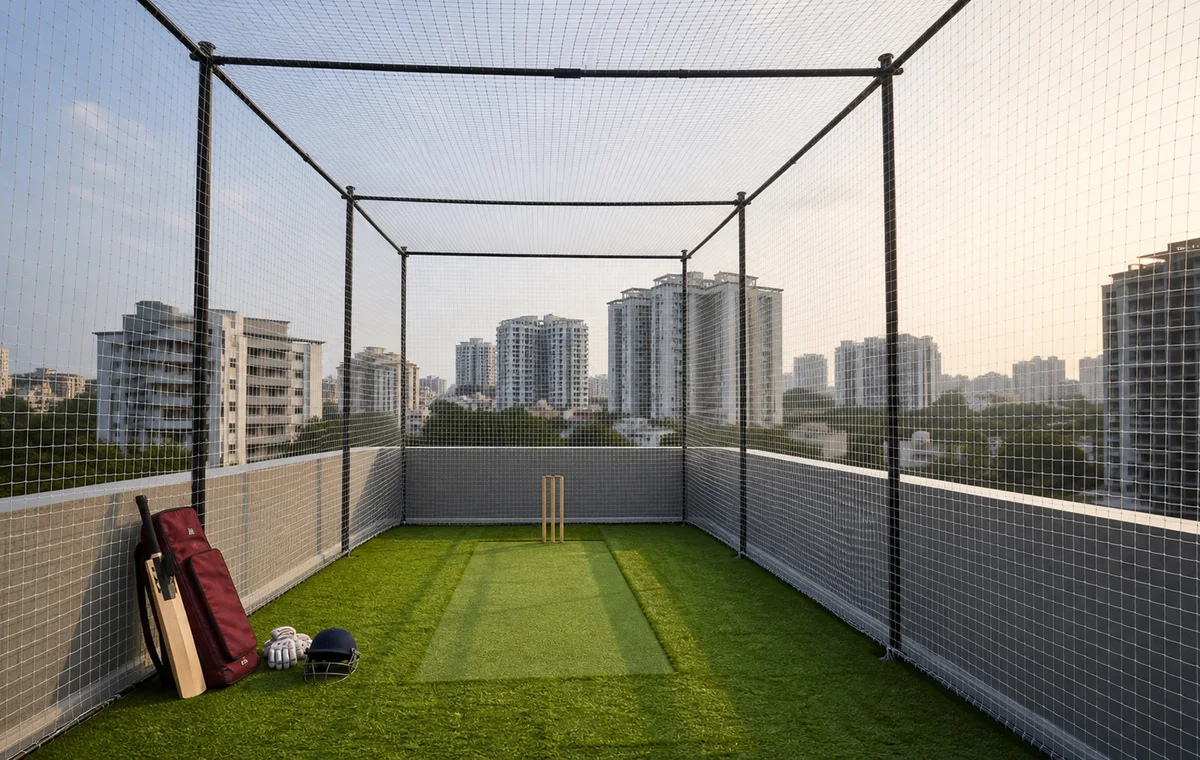
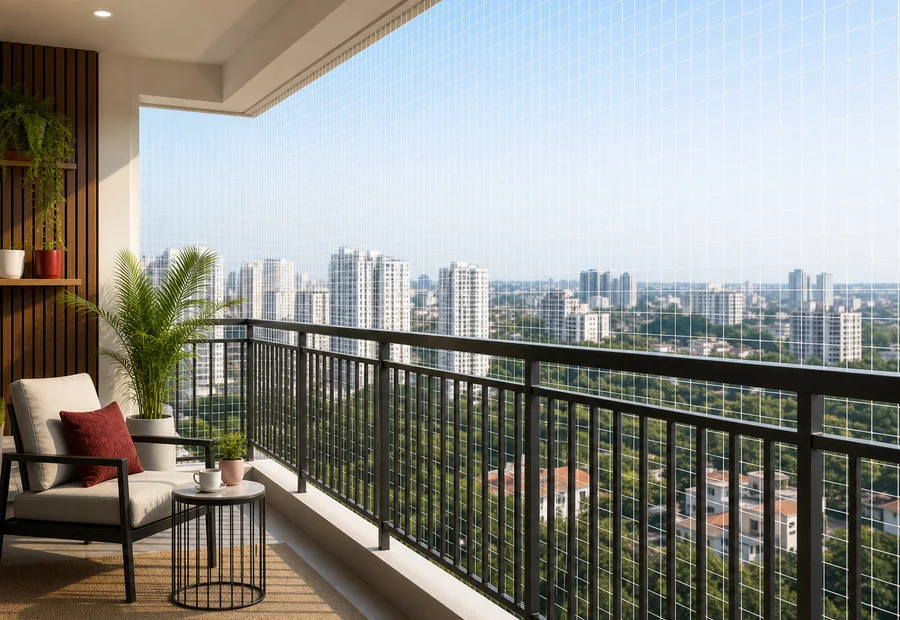
Installation views
These views show the kind of balcony faces, window openings, and utility areas that need measured installation instead of a quick one-size-fits-all setup.
Materials
The net is only one part of the job. A reliable installation also needs the correct mesh size, edge support, fixing points, and a finish that works with the balcony surface.
| Part | Ask this | Good choice | Why it matters |
|---|---|---|---|
| Net strength | Is the net heavy-duty enough for monkey entry prevention? | Thicker nylon or HDPE net chosen for stronger pulling and outdoor use | Monkey netting takes more stress than pigeon netting, especially near reachable edges and railings. |
| Mesh size | Will the mesh size stop entry without creating large hand-hold gaps? | Small, even mesh with a tighter pattern than general open-area netting | Large gaps can become grip points or leave enough space near corners for entry. |
| Border rope or cable | How will the edge be supported and tightened? | Strong border rope, support cable, or reinforced edge line | Most monkey-net failures happen where the border is loose or poorly anchored. |
| Hooks and anchors | Are the anchors suitable for wall, ceiling, railing, and terrace surfaces? | Rust-resistant hooks, clamps, or anchors selected after surface inspection | The fixing points carry the real stress when the net is pulled or exposed to wind. |
| Access and safety | How will high or exterior-facing work be accessed safely? | Measured access plan using the right ladder, support, and working method | A difficult exterior edge should not be priced or installed like an easy indoor opening. |
Ask this
Is the net heavy-duty enough for monkey entry prevention?
Good choice
Thicker nylon or HDPE net chosen for stronger pulling and outdoor use
Why it matters
Monkey netting takes more stress than pigeon netting, especially near reachable edges and railings.
Ask this
Will the mesh size stop entry without creating large hand-hold gaps?
Good choice
Small, even mesh with a tighter pattern than general open-area netting
Why it matters
Large gaps can become grip points or leave enough space near corners for entry.
Ask this
How will the edge be supported and tightened?
Good choice
Strong border rope, support cable, or reinforced edge line
Why it matters
Most monkey-net failures happen where the border is loose or poorly anchored.
Ask this
Are the anchors suitable for wall, ceiling, railing, and terrace surfaces?
Good choice
Rust-resistant hooks, clamps, or anchors selected after surface inspection
Why it matters
The fixing points carry the real stress when the net is pulled or exposed to wind.
Ask this
How will high or exterior-facing work be accessed safely?
Good choice
Measured access plan using the right ladder, support, and working method
Why it matters
A difficult exterior edge should not be priced or installed like an easy indoor opening.
Compare
Monkey Safety Nets can be the right answer for many homes, but it is not the right answer for every balcony or window problem. This comparison keeps the decision honest.
| Option | Best for | Strength | Limitation | Choose when |
|---|---|---|---|---|
| Monkey safety net | Balconies, terraces, and open sides where monkeys can enter | Stronger material and edge fixing for animal-entry prevention | More visible than invisible grills and needs careful edge maintenance | The main problem is monkey entry, pulling, disturbance, or repeated visits to the balcony. |
| Pigeon safety net | Bird entry, droppings, nesting, and AC ledge issues | Keeps bird entry under control while preserving airflow | Usually too light for monkey-entry prevention | The issue is pigeons or smaller birds, not stronger animal movement. |
| Balcony safety net | Child, pet, and general open-edge safety | Good broad safety coverage for everyday apartment use | May need heavier material if monkey entry is a known problem | The priority is fall-prevention style safety more than animal entry control. |
| Invisible grill | Open-view safety with a cleaner cleaner look | Neat cable finish and stronger balcony edge protection | Gaps may not stop monkey reach or entry unless planned separately | You want view-friendly safety and monkey activity is not the main issue. |
| Traditional metal grill | Permanent visible barrier and stronger physical separation | Strong, familiar, and more rigid than netting | Changes balcony look, blocks view, and may need society approval | A permanent metal barrier is allowed and appearance is less important. |
Best for
Balconies, terraces, and open sides where monkeys can enter
Strength
Stronger material and edge fixing for animal-entry prevention
Limitation
More visible than invisible grills and needs careful edge maintenance
Choose when
The main problem is monkey entry, pulling, disturbance, or repeated visits to the balcony.
Best for
Bird entry, droppings, nesting, and AC ledge issues
Strength
Keeps bird entry under control while preserving airflow
Limitation
Usually too light for monkey-entry prevention
Choose when
The issue is pigeons or smaller birds, not stronger animal movement.
Best for
Child, pet, and general open-edge safety
Strength
Good broad safety coverage for everyday apartment use
Limitation
May need heavier material if monkey entry is a known problem
Choose when
The priority is fall-prevention style safety more than animal entry control.
Best for
Open-view safety with a cleaner cleaner look
Strength
Neat cable finish and stronger balcony edge protection
Limitation
Gaps may not stop monkey reach or entry unless planned separately
Choose when
You want view-friendly safety and monkey activity is not the main issue.
Best for
Permanent visible barrier and stronger physical separation
Strength
Strong, familiar, and more rigid than netting
Limitation
Changes balcony look, blocks view, and may need society approval
Choose when
A permanent metal barrier is allowed and appearance is less important.
Process
Good monkey safety nets work should feel measured and calm. The installer has to understand the opening, fixing points, safety expectation, and how the space will be used after the job.
The first step is to understand whether monkeys are using trees, pipes, railings, terrace parapets, or nearby structures to reach the opening.
The installer should measure the full opening and identify corners, support points, railing bends, and surfaces that may need stronger anchors.
Material thickness, mesh size, edge rope, and fixing method are selected based on the opening, wind exposure, and how reachable the net will be.
The net is fixed with attention to edges and corners because monkeys usually test reachable weak points before the centre of the net.
After installation, the space should be checked for open gaps, loose items, food attraction, and future access needs for cleaning or repair.
Share photos of trees, railings, pipe routes, terrace edges, and the exact entry side.
Confirm whether the net is stronger than standard pigeon netting.
Check whether side gaps and top corners are included in the fitting plan.
Ask how the installer will handle exterior-facing or high balcony work safely.
Avoid weak temporary mesh if monkeys can reach and pull the net.
Do not leave food waste, fruit, or open bins visible after installation.
Keep future AC service, painting, cleaning, and terrace access in mind before fixing.
Check border ropes and anchor points after strong wind, painting work, or any heavy pulling.
Do not tie swings, plants, clothes rods, or heavy items to monkey safety netting.
Keep balcony food waste and open packets away so monkeys are not encouraged to return.
Call for a tightening check if any edge sags, loosens, or starts rubbing against a sharp surface.
Areas
Start with the nearest area page. Marathahalli is the business base, and the same service route is available across Bangalore.
Open page
Open page
Open page
Open page
Open page
Open page
Open page
Open page
Open page
Open page
Open page
Open page
Open page
Open page
Open page
GMB location
Open page
Open page
Open page
Open page
Open page
FAQ
These answers are written for real buying decisions: material, drilling, airflow, children, pets, and future repair work.
A monkey safety net is a stronger protective net fitted across balconies, terraces, windows, or open sides to reduce monkey entry. It works as a passive barrier and should be installed without harming animals.
Usually no. Pigeon netting is designed mainly for bird entry control. Monkey safety work needs heavier net, stronger borders, and better fixing points because the net may be pulled or gripped.
Yes, terraces can be covered, but larger spans need proper support lines, strong anchors, and careful planning for wind exposure and future access.
A good net should allow air and light through the mesh, but it will be more visible than a light bird net because the material needs to be stronger.
Sometimes clamps or existing points can be used, but many monkey safety jobs need stronger anchors. The correct method depends on wall, railing, ceiling, and terrace conditions.
It should be planned as a barrier, not as a trap. Avoid sharp, electric, or harmful deterrents. The goal is to prevent entry while keeping the animal outside the home space.
Monkey safety net visits are planned from Marathahalli toward Whitefield, Bellandur, KR Puram, Sarjapura, Yelahanka, JP Nagar, Kanakapura Road, RR Nagar, Kengeri, Thanisandra, and nearby terrace or tree-facing pockets where stronger border support is needed.
Search the service with your Bangalore area to open the correct matching page path.
Marathahalli, Bangalore
Share the service, area, and a few photos of the opening. The visit can be planned around the surface, access, material, and daily use of the space.